
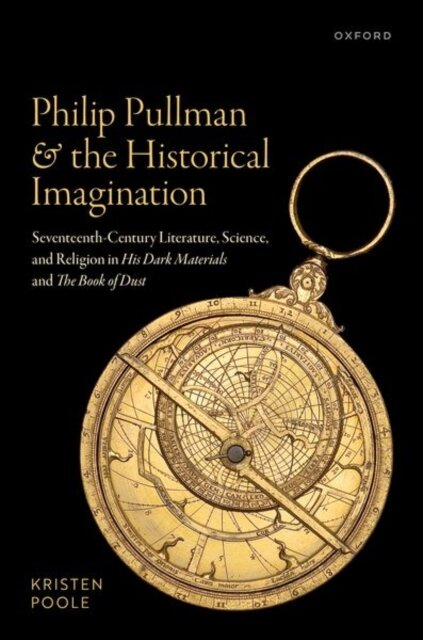
Philip Pullman and the Historical Imagination
€55.90
Product Information
| ISBN | 9780192889317 |
|---|---|
| Authors | Kristen Poole |
| Publisher | Oxford University Press |
| Format | Hardcover |
| Number of pages | 272 |
| Weight (kg) | 0.614 |
| Publishing Date | 10/04/2025 |
| Price (excl. tax) | €52.74 |
| Tax | €3.16 |
| Price (incl. tax) | €55.90 |
| Availability | 3 units in external warehouse |
Product Description
Philip Pullman and the Historical Imagination takes the general reader on a fascinating tour of seventeenth-century thought, exploring how this time period shaped Pullman''s extraordinary trilogies His Dark Materials and The Book of Dust. In Part One, readers are taken into the mysteries of Renaissance allegory and hieroglyphics, tracing how the alethiometer and Lyra''s way of reading the device emerged from these traditions. Part Two enters the exciting and revolutionary world of seventeenth-century science. We see how the amber spyglass imitates Galileo''s telescope, how early modern fantasies of space travel led to ideas of multiple worlds, how alchemy entered Lyra''s later adventures in Oxford and Prague, and how the concept of Dust shares in the physics and philosophies of early scientists like Margaret Cavendish. Part Three invites readers into the thrilling epic poem Paradise Lost--John Milton''s dramatic account of the creation of the world following a violent war in Heaven--that was Pullman''s inspiration for His Dark Materials. Pullman''s vibrant re-telling of this core story brings us rebel angels, recasts Satan as a brooding Lord Asriel, and presents Lyra as the new Eve.Written by an eminent scholar of seventeenth-century literature and history, Philip Pullman and the Historical Imagination is crafted in an engaging and accessible style aimed at popular readers and fans of Pullman''s work. It enlivens a historical period that has long attracted Pullman himself, bringing to life intriguing figures and the richly complex ideas of the time. This book is an exploration of history through the worlds and characters Pullman has invented. Ultimately, it not only reveals how seventeenth-century history helps readers better understand Pullman''s novels, but shows how reading history through the lens of Pullman''s imagination offers new ways of thinking about the past.