
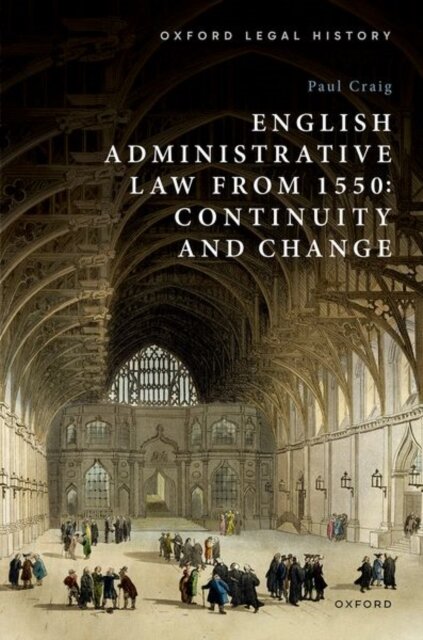
English Administrative Law from 1550
€234.90
Product Information
| ISBN | 9780198908326 |
|---|---|
| Authors | Paul Craig |
| Publisher | Oxford University Press |
| Format | Hardcover |
| Number of pages | 752 |
| Weight (kg) | 1.354 |
| Publishing Date | 20/05/2024 |
| Price (excl. tax) | €221.60 |
| Tax | €13.30 |
| Price (incl. tax) | €234.90 |
| Availability | 2 units in external warehouse |
Product Description
The commonly held view about English administrative law is that it is of recent origin, with some dating it from the mid-20th century and some venturing back to the late 19th century. English Administrative Law from 1550: Continuity and Change upends this conventional thinking, charting its development from the mid-16th century with an in-depth examination of administrative law doctrine based on primary legal materials, statute, and case law. This book is divided into four parts. Part I sets out the book''s principal thesis, contrasting standard perceptions concerning the existence of English administrative law with the reality of its emergence from the mid-16th century. Part II is concerned with Regulation and Administration from the mid-16th century to the end of the 19th century. There is detailed analysis of the regulatory and administrative state, which includes chapters on the way in which administrative policy was developed through individual decision-making and rulemaking, and the role played by contract in service delivery. Part III deals with Courts and Doctrine. It begins with discussion of foundational precepts followed by chapters on natural justice; review of law and fact; rights; delegation, fettering and purpose; reasonableness; proportionability; prerogative; and third and fourth source power. Part IV of the book covers Remedies and Review, with chapters on invalidity; standing; the prerogative writs; injunction, declaration, quo warranto and habeas corpus; and damages and restitutionary liability. With thought-provoking and original insights, English Administrative Law from 1550 systematically elaborates and contextualizes the origins of administrative law features while linking them to their modern-day equivalents.