
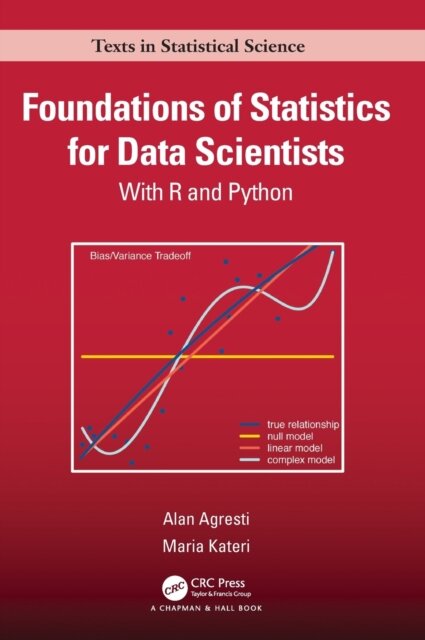
Foundations of Statistics for Data Scientists
€165.90
Product Information
| ISBN | 9780367748456 |
|---|---|
| Authors | Alan Agresti, Maria Kateri |
| Publisher | Taylor & Francis Ltd |
| Format | Hardcover |
| Number of pages | 468 |
| Weight (kg) | 1.132 |
| Publishing Date | 30/11/2021 |
| Price (excl. tax) | €156.51 |
| Tax | €9.39 |
| Price (incl. tax) | €165.90 |
| Availability | 1 unit in external warehouse |
Product Description
Foundations of Statistics for Data Scientists: With R and Python is designed as a textbook for a one- or two-term introduction to mathematical statistics for students training to become data scientists. It is an in-depth presentation of the topics in statistical science with which any data scientist should be familiar, including probability distributions, descriptive and inferential statistical methods, and linear modeling. The book assumes knowledge of basic calculus, so the presentation can focus on "why it works" as well as "how to do it." Compared to traditional "mathematical statistics" textbooks, however, the book has less emphasis on probability theory and more emphasis on using software to implement statistical methods and to conduct simulations to illustrate key concepts. All statistical analyses in the book use R software, with an appendix showing the same analyses with Python.
Key Features:
- Shows the elements of statistical science that are important for students who plan to become data scientists.
- Includes Bayesian and regularized fitting of models (e.g., showing an example using the lasso), classification and clustering, and implementing methods with modern software (R and Python).
- Contains nearly 500 exercises.
The book also introduces modern topics that do not normally appear in mathematical statistics texts but are highly relevant for data scientists, such as Bayesian inference, generalized linear models for non-normal responses (e.g., logistic regression and Poisson loglinear models), and regularized model fitting. The nearly 500 exercises are grouped into "Data Analysis and Applications" and "Methods and Concepts." Appendices introduce R and Python and contain solutions for odd-numbered exercises. The book''s website (http://stat4ds.rwth-aachen.de/) has expanded R, Python, and Matlab appendices and all data sets from the examples and exercises.