
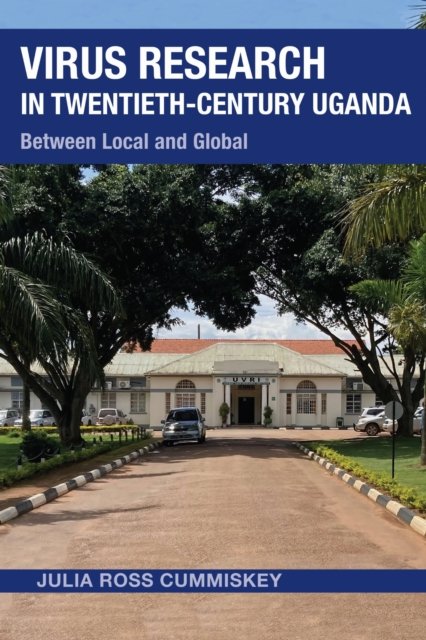
Virus Research in Twentieth-Century Uganda
€37.90
Product Information
| ISBN | 9780821425695 |
|---|---|
| Authors | Julia Ross Cummiskey |
| Publisher | Ohio University Press |
| Format | Paperback |
| Number of pages | 322 |
| Weight (kg) | 0.470 |
| Publishing Date | 10/12/2024 |
| Price (excl. tax) | €35.75 |
| Tax | €2.15 |
| Price (incl. tax) | €37.90 |
| Availability | 1 unit in external warehouse |
Product Description
Virus Research in Twentieth-Century Uganda presents the stories of scientists at the Uganda Virus Research Institute (UVRI), a biomedical center founded in 1936. The book analyzes the strategies and conditions that allowed the institute to endure and thrive through successive political and scientific regimes of the interwar period, the postwar period, the transition to independence, the conflicts of the 1970s and 1980s, and the Museveni presidency. Julia Ross Cummiskey combines methods and themes from the history of medicine and public health, science and technology studies, and African studies to show that the story of the UVRI and the people who worked there transforms our understanding of the nature of local and international expertise and the evolution of global health research over the course of the twentieth century. Global health is one of the chief areas in which African and foreign institutions interact today. Billions of dollars are invested in global health projects on the continent, many involving strategically selected “local partners.” In the discourse of these projects, local and global are often framed as complementary but distinct categories of people, institutions, traditions, and practices. But the history of biomedical research at the UVRI shows that these distinctions are unstable and mutable and that people and institutions have mobilized both categories to attract funding, professional prestige, and research opportunities. The book complicates the local/global binary that is implicit (and sometimes explicit) in many studies of colonial, international, and global health and medical research, especially in Africa. Moreover, it challenges assumptions about global health as an enterprise dominated by researchers based in the Global North and recenters the history of biomedicine in Africa.