
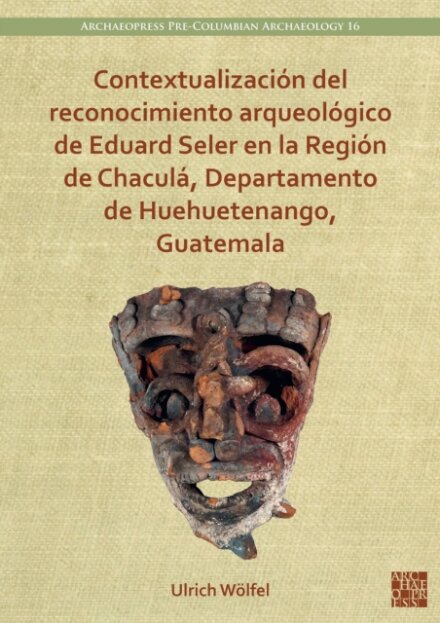
Contextualizacion del reconocimiento arqueologico de Eduard Seler en la Region de Chacula, Departamento de Huehuetenango, Guatemala
€103.90
Product Information
| ISBN | 9781803272856 |
|---|---|
| Authors | Ulrich Wolfel |
| Publisher | Archaeopress |
| Format | Paperback |
| Number of pages | 416 |
| Weight (kg) | 1.532 |
| Publishing Date | 14/07/2022 |
| Price (excl. tax) | €98.02 |
| Tax | €5.88 |
| Price (incl. tax) | €103.90 |
| Availability | 1 unit in external warehouse |
Product Description
This study re-examines and contextualises Eduard Seler''s investigations in the Chaculá-Region (Department of Huehuetenango, Guatemala). Starting with a discussion of ethnohistory as well as the historical circumstances of Seler''s research, his methods are critically examined in the context of archaeology in late 19th century Guatemala and the practice of collecting by European museums, specifically the Ethnological Museum Berlin. This is followed by the results of a reconnaissance of the different archaeological sites documented by Seler in the region, in which their current state of preservation is examined and Seler''s excavation trenches are re-discovered. The core of the work is a new study of the materials from the region in the collection of the Ethnological Museum Berlin, including previously undocumented ceramic materials. Through typological cross-dating, a first ceramic chronology for the region is established, showing that the major settlements were occupied from the Late Classic (600-900) to the Early Postclassic (900-1250). These data and observations form the foundation for a re-examination of the interpretations put forth by Eduard Seler and later scholars, concerning topics such as architecture, burials and caches, the function of the Quen Santo caves, ritual and settlement continuity from the Late Classic to modern times and the ethnolinguistic identity of the ancient inhabitants of the region. The book concludes with a look at the postcolonial challenges that the collection in Berlin faces and ways to connect the archaeological past with the indigenous present in the Chaculá-Region.